A dinosaur skeleton cast and cousin of the Tyrannosaurus rex moves onto campus from the Bisti Wilderness Area in New Mexico, also known as the Bisti Badlands.
The fossil is being loaned to the college for undergraduate research this semester, professor of geosciences, Gary Gianniny said. But how is the cast coming to Fort Lewis College?
The most recent discovery of the dinosaur was found on the reservation by a Navajo man, and it is the most complete specimen found of the Bistahieversor sealeyi (pronounced: Bist-ah-ee-versor see-lee-eye), John Hankla, a paleontologist and research assistant for the Denver Museum of Nature and Science, said.
The recent discovery was found in the shale rocks of the Kirtland formation and copied to create a Bistahieversor sealyi cast, Hankla said.
Three previous discoveries helped to fill in the blanks and mold the missing pieces to form a complete cast, Hankla said.
In the field of geology, dinosaurs provide a catalyst for intellect and imagination through hands-on experiences with fossils from the ancient world, Hankla said.
One person can find a dinosaur, but that is only the first step of the process, Hankla said.
Afterward, the process of removing the bones and wrapping them in plaster can take anywhere from five to 20 volunteers, Hankla said.
The undertaking of rebuilding the skeleton is called fossil prep, and this can take years to finish, Hankla said.
Each discovery is a collaboration that takes many experts and volunteers to complete, Hankla said.
The dinosaur came to campus through a National Science Foundation CURE grant that provided funding for a short-term loan of the cast, Missy Thompson said.
Thompson is an associate professor of health and human performance who helped get the grant for the college and develop courses around the grant.
CURE stands for Course-Based Undergraduate Research Experiences, and the program is built to help fund projects that allow students to develop critical thinking skills in an engaging way, Thompson said.
The grant provides $230,000 of funding for the next three years, for five faculty members per year, Thompson said.
Professor Gary Gianniny applied for his Historical Geology course to be a CURE course and is now a part of the second cohort of classes that have used the grant since it was implemented during the fall semester of 2023, Thompson said.
The Historical Geology course is using the dinosaur for the first six weeks of the class as a vehicle to contextualize information, Gianniny said.
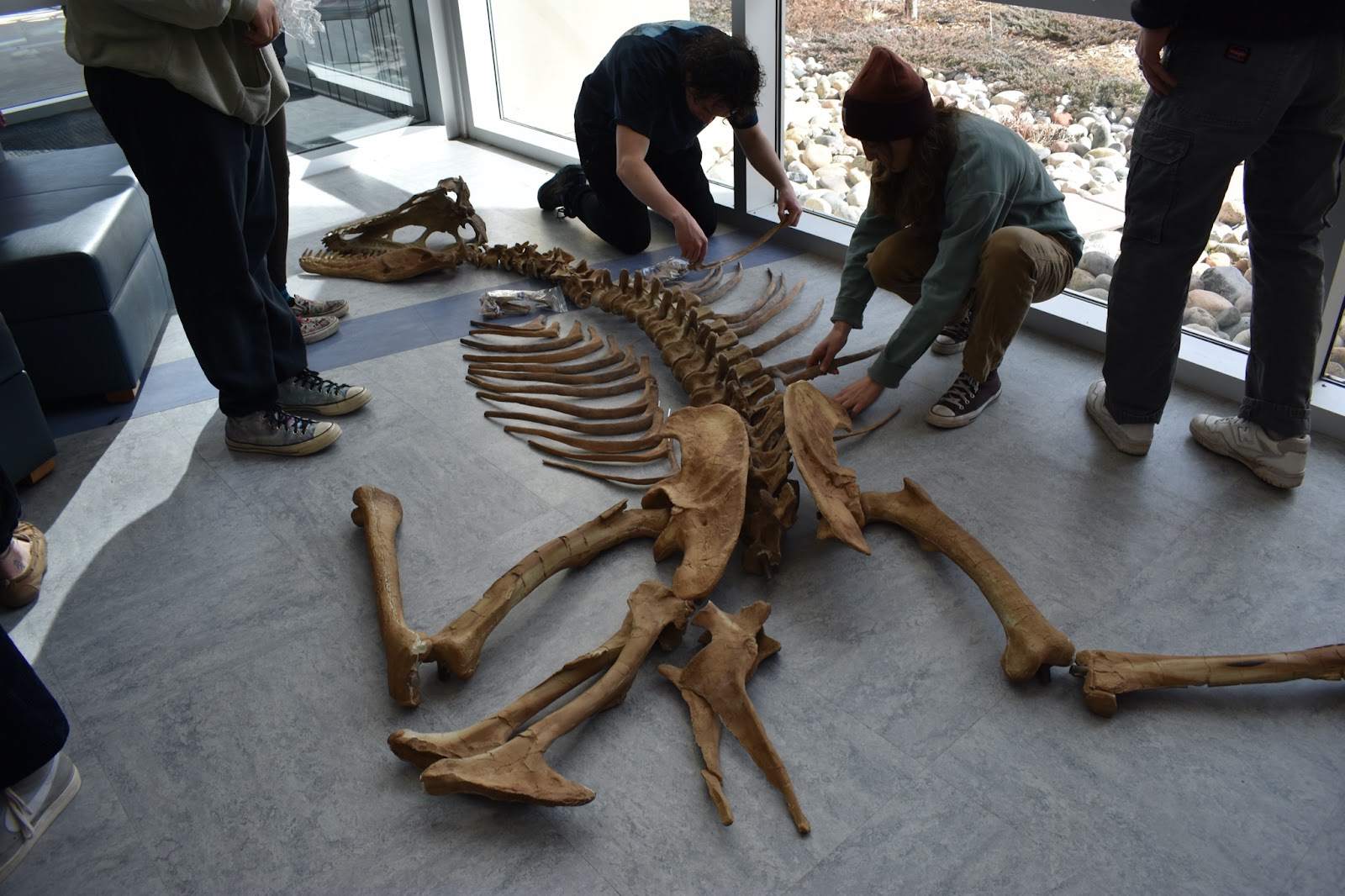
With this lens on the course, students have the chance to work together to build in-depth questions about the dinosaur cast, Gianniny said.
Eryn Hilyard, a geology major in the class, said learning about the amount of time the dinosaur bones must survive to be discovered has been an interesting process.
Molly Mabee, a teacher's assistant and geology major, said students can begin putting the pieces together, and the cast provides a new perspective.
“Being exposed to paleontology has been really fascinating,” Hilyard said.